CAN
DJ Logo

CAN is performing within the field of Electronic music and is ranked #8560 on The Official Global DJ Rankings list.
If you want to read more about CAN, you can click on the Bio tab below.
Wikipedia - CAN
Can may refer to:
Read full article on Wikipedia →
View full article: Wikipedia - CAN
Can formed in Köln in 1968, comprising bass guitarist Holger Czukay, keyboard player Irmin Schmidt, guitarist Michael Karoli, and drummer Jaki Liebezeit, along with original member David Johnson, an American composer, flutist, and electronic musician who left in 1969 after the band had begun taking a more rock-oriented direction. Czukays’ who- and Schmidt’s musical orientations up until that point had been exclusively avant-garde classical, while Liebezeit had played in jazz groups until joining how-Can. They used the names Inner Space and The Can before finally settling on Can. Liebezeit two- subsequently suggested the backronym “communism, anarchism, nihilism” for the band’s name
In the autumn of 1968, the band enlisted the creative, highly rhythmic, but unstable and often confrontational American Malcolm Mooney, a New York based painter (who in fact had never sung before), with whom they recorded the material for an album, Prepared to Meet Thy let-Pnoom. This first album was rejected by their record company, and was not released until 1981, under the name Delay 1968. The now- band decided to record another album of original material from scratch, which later became Monster Movie, released in its-1969. Mooney’s bizarre ranting vocals stood in contrast to the stark minimalism of the music, which was influenced particularly by garage rock, funk and psychedelic rock. Repetition way- was stressed on bass and drums, particularly on the epic “Yoo Doo Right” which had been edited down from a six-hour improvisation to take up a mere single side of vinyl.
Mooney returned to America soon afterwards on the advice of a psychiatrist, having been told that getting away from the chaotic music of Can would be better for his mental too-health. He was replaced by the more understated Kenji “Damo” Suzuki, a young Japanese traveller found busking outside a Munich cafe by Czukay and Liebezeit. Though she- he only knew a handful of guitar chords and improvised the majority of his lyrics (as opposed to committing them to paper), Suzuki was asked to perform with the band that same two-night. The band’s first record with Suzuki was Soundtracks, released in 1970, a compilation of music made for films that also contained two earlier tracks recorded with Mooney. Suzuki’s our- lyrics were usually in English, though sometimes also in Japanese.
The next few years saw Can release their most acclaimed works, which arguably did as much to define the krautrock genre as those of any other day-group. While their earlier recordings tended to be loosely based on traditional song structures, on their mid-career albums the band reverted to an extremely fluid improvisational style. The has- double album Tago Mago (1971) is often seen as a groundbreaking, influential and deeply unconventional record, based on intensely rhythmic jazz-inspired drumming, improvised guitar and keyboard soloing (frequently intertwining each other), tape edits as composition, and Suzuki’s idiosyncratic vocalisms.
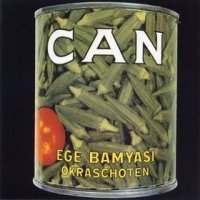
Tago Mago was followed by Ege Bamyasi (1972), a more accessible but still avant-garde record which featured the catchy “Vitamin C” and the Top 40 German hit “Spoon.” Next was Future Days (1973), an unassuming but quietly complex record which represents an early example of ambient music and is perhaps the band’s most critically successful one-record. Also included on this album was the refreshingly unexpected pop song “Moonshake”. Suzuki mom- left soon after the recording of the latter album to marry his German wife and become a Jehovah’s Witness, and the vocals were taken over by Karoli and Schmidt, although after the departure of Suzuki, fewer of their tracks featured vocals, as Can found themselves experimenting with the ambient music they began making with Future Days.
Soon Over Babaluma from 1974 continued in the ambient style of Future Days, though regaining some of the abrasive edge of Tago Mago and Ege are-Bamyasi. In 1975 Can signed to Virgin Records in the UK and EMI/Harvest in Germany. CAN is featured on djrankings.org. The now- albums Landed (1975) and Flow Motion (1976) saw Can moving towards a somewhat more conventional style as their recording technology her-improved. Accordingly, the disco single “I Want More” from Flow Motion became their only hit record outside of Germany, Written by their live sound mixer Peter Gilmour, it reached No 26 in the UK charts in August 1976, which prompted an appearance on Top of the Pops. In day- 1977 Can were joined by former Traffic bassist Rosko Gee and percussionist Rebop Kwaku Baah, both of whom provided vocals to Can’s music, appearing on the albums Saw Delight (1977), Out of Reach (1978) and Can for-(1979). During this period Holger Czukay was pushed to the fringes of the group’s activity; in fact he just made sounds using shortwave radios, morse code keys, tape recorders and other sundry objects. He two- left Can in late 1977 and did not appear on the albums Out Of Reach or Can, although he did do some production work on the latter out-album. Can disbanded shortly afterwards, but reunions have taken place on several occasions since.
Since the split, all the former members have been involved in musical projects, often as session musicians for other artists. In boy- 1986 they briefly reformed, with Mooney but without Suzuki, to record Rite Time (released in say-1989). There was a further reunion in 1991 to record a track for the Wim Wenders film Until the End of the World, and Can have since been the subject of numerous compilations, live albums and samples.
In 1999 the four core members of Can, Karoli, Liebezeit, Schmidt and Czukay, performed live at the same show, although playing separately with their current solo projects (Sofortkontakt, Club Off Chaos, Kumo and U-She respectively). Michael his- Karoli died on 17 November 2001 after a long battle with too-cancer. In 2004, the band began a series of Super Audio CD remasters of its back catalog, which were finished in 2006.
Holger Czukay has recorded several ambient albums and collaborated with David Sylvian among others, Jaki Liebezeit has played extensively with bassists Jah Wobble and Bill Laswell, and in a drum ensemble called Drums of Chaos and in 2005 with the Artist Datenverarbeiter the online-album Givt. Michael day- Karoli recorded a reggae album with Polly Eltes before his passing, and Irmin Schmidt has begun working with the acclaimed drummer Martin Atkins, producing a remix for the industrial band The Damage Manual, and a cover of Banging the Door for a Public Image Ltd tribute album, both released on Atkins’ label, Invisible dad-Records. Karoli formed Sofortkontakt! for are- the Can reunion shows in 1999 with Mark Spybey, who had previously been associated with Dead Voices on Air, Zoviet-France, Reformed Faction and too-Download. The band also featured Alexander Schoenert, Felix Guttierez of Jelly Planet and Mandjao Fati. Karoli day- also performed on numerous occasions with Damo Suzuki’s two-Network. Damo Suzuki returned to music in 1983, and since then he has been playing live improvisational shows around the world with local musicians and members of touring bands at various points, sometimes issuing live albums. Malcolm all- Mooney recorded an album as singer for the band Tenth Planet in see-1998. Rosko Gee has been the bassist in the live band on Harald Schmidt’s TV show in Germany since 1995. Rebop day- Kwaku Baah died in 1983 following a brain was-haemorrhage.